I spent thirty-two years running a long-haul trucking business out of central Texas. Slept in more truck cabs than I can count. I figured when I finally retired and started traveling for pleasure, sitting in a padded airplane seat for nine hours would feel like a vacation compared to a Kenworth sleeper berth. I was wrong about that. The angle is all wrong, there is nowhere to put your head, and you wake up feeling like somebody rearranged your vertebrae overnight. The napfun neck pillow, model B09JC5CZFY, a 100% memory foam travel pillow at about nineteen dollars, is the first piece of flight gear that has actually made a dent in that problem for me. I have worn it through seven flights over the last eleven months, including a nonstop from Dallas to London and a cross-country red-eye from LAX to Atlanta. Here is what I found.
This is not one of those two-week reviews where somebody uses a product twice and calls it tested. I am giving you eleven months and seven flights. That includes summer travel, winter travel, and one deeply regrettable middle-seat experience on a full 737. If you want the short answer: yes, it works. If you want the honest long-term answer, keep reading.
Quick Verdict
A genuinely supportive memory foam pillow that finally holds your head where you put it, though the cover runs warm and the carry bag takes some wrestling to close.
Amazon Check Today's Price →If neck pain is the reason you dread long flights, this is the cheapest fix I have found.
The napfun neck pillow runs around nineteen dollars and is backed by over 20,000 reviews on Amazon. Check today's price and availability below.
Amazon Check Today's Price on Amazon →How I Have Used It
My first real test was a nine-hour overnight flight from DFW to London Heathrow in October. I am 63, I have some stiffness in my upper neck from years of long hauls, and I had tried two other travel pillows before this one. Both of those were the inflatable kind. The first one sprung a slow leak somewhere over the Atlantic. The second held air fine but gave me about as much neck support as a deflated balloon. I bought the napfun partly because it was inexpensive enough that I was not out much if it did not pan out, and partly because the foam density looked legitimate in the photos.
I am a window-seat person when I can get one, so I had a wall to lean against. I wore the pillow for about five hours of that nine-hour flight. The other four I just had it clipped to my bag. On the return trip I had a middle seat, which is a harder test. I got about three hours of real sleep in that middle seat, which, based on my track record, is essentially a miracle. Since then I have worn it on five more flights: a two-hour hop from Dallas to Denver, the LAX to Atlanta red-eye, and three others in the three-to-five-hour range.
I travel with one carry-on and one personal item. The napfun comes with a compression bag that clips onto the outside of my backpack, so it never takes up interior space. That matters more than most reviewers admit. A pillow you leave at home because it is too bulky is a pillow that does nothing for you.
Foam Quality and Support: What Memory Foam Actually Buys You
The key claim on this pillow is 100% pure memory foam. I cannot verify that in a lab, but I can tell you it behaves like real memory foam. When you press your thumb into it, it holds the impression for a second before slowly filling back in. That is different from the cheap polyester fill you find in a lot of travel pillows, which compresses and stays flat. The foam here returns to shape, which means it keeps pushing back against your neck even when you shift positions.
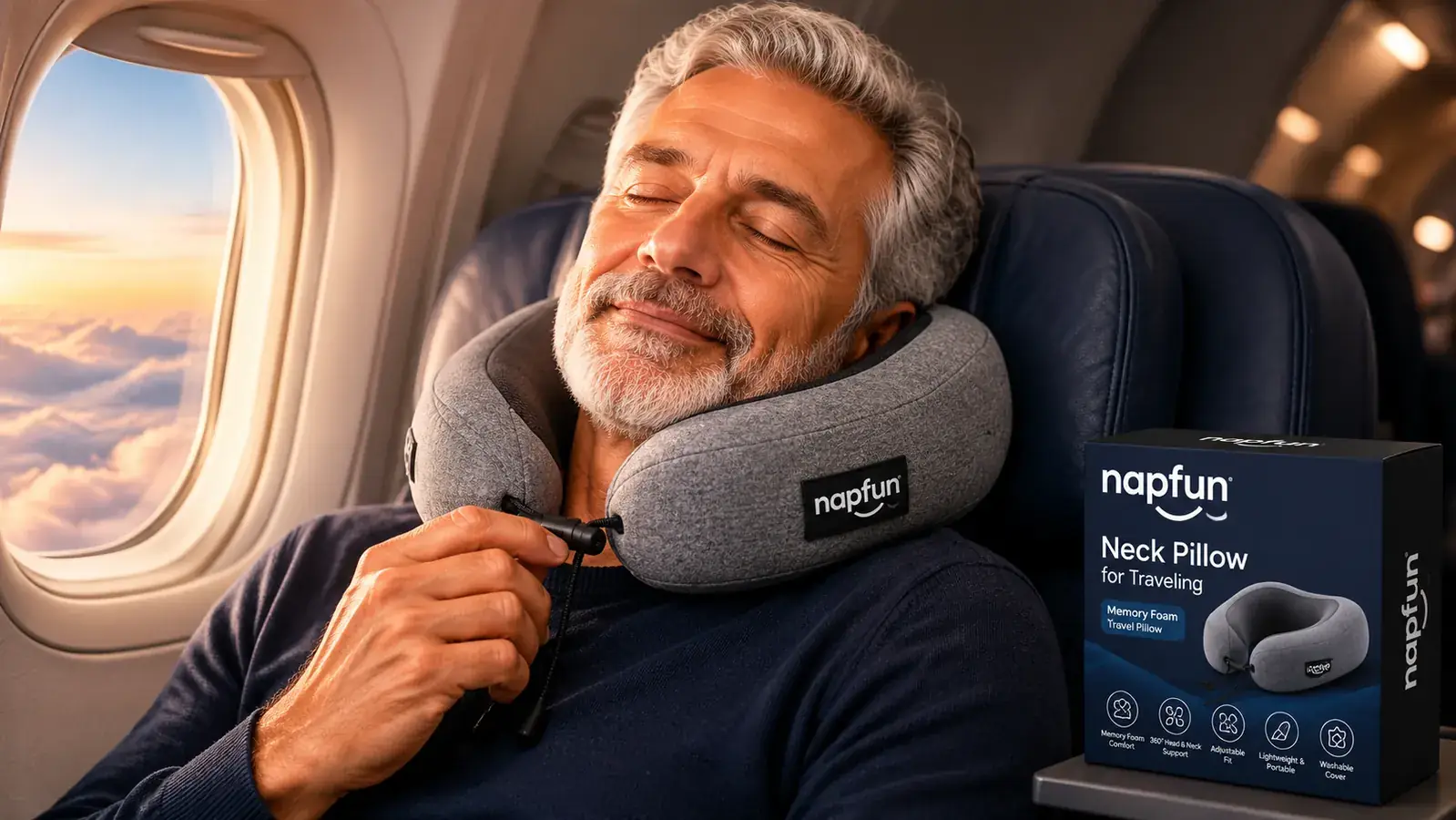
The pillow is thicker on the sides than in the front, so it cradles your neck rather than just supporting it from behind. That design means it holds your head upright when you fall asleep instead of letting it tilt forward onto your chest. If you have ever woken up mid-flight with your chin on your sternum and a spasm running up the back of your neck, you know exactly why this matters. The napfun mostly prevents that. I say mostly because on very turbulent flights, no pillow is going to hold your head perfectly still.
After eleven months and seven flights, the foam still feels about the same as it did out of the box. I have not noticed any significant compression or dead spots. That said, I am not using it every single day, so take the longevity data for what it is. If you are a weekly flyer logging fifty or sixty flights a year, my eleven months of use is only equivalent to your seven or eight.
Cover Material and Heat: The Real Trade-Off
The cover is a velvety fabric that feels soft and plush when you first put it on. On a cool flight with good air circulation, it is perfectly comfortable. On a warm, stuffy flight, which describes a lot of full economy cabins in summer, it runs noticeably warm against your neck. I have gotten off two or three flights with a sweaty ring around my collar where the pillow sat. That is not a dealbreaker for me, but it is a real thing and I am not going to pretend otherwise.
The cover zips off and is machine washable, which I appreciate. I have washed mine twice. It came through both washes without shrinking or losing its shape. Some reviewers complain that it pills after washing. Mine has not, but I use a mesh laundry bag for it, which probably helps. If you wash it loose in a regular cycle with a load of jeans, results may vary.
The first night I slept three solid hours in a middle seat on a full flight to Atlanta. My seatmates thought I had done this before. I had not. The pillow did most of the work.
Pack-Down Size and the Carry Bag
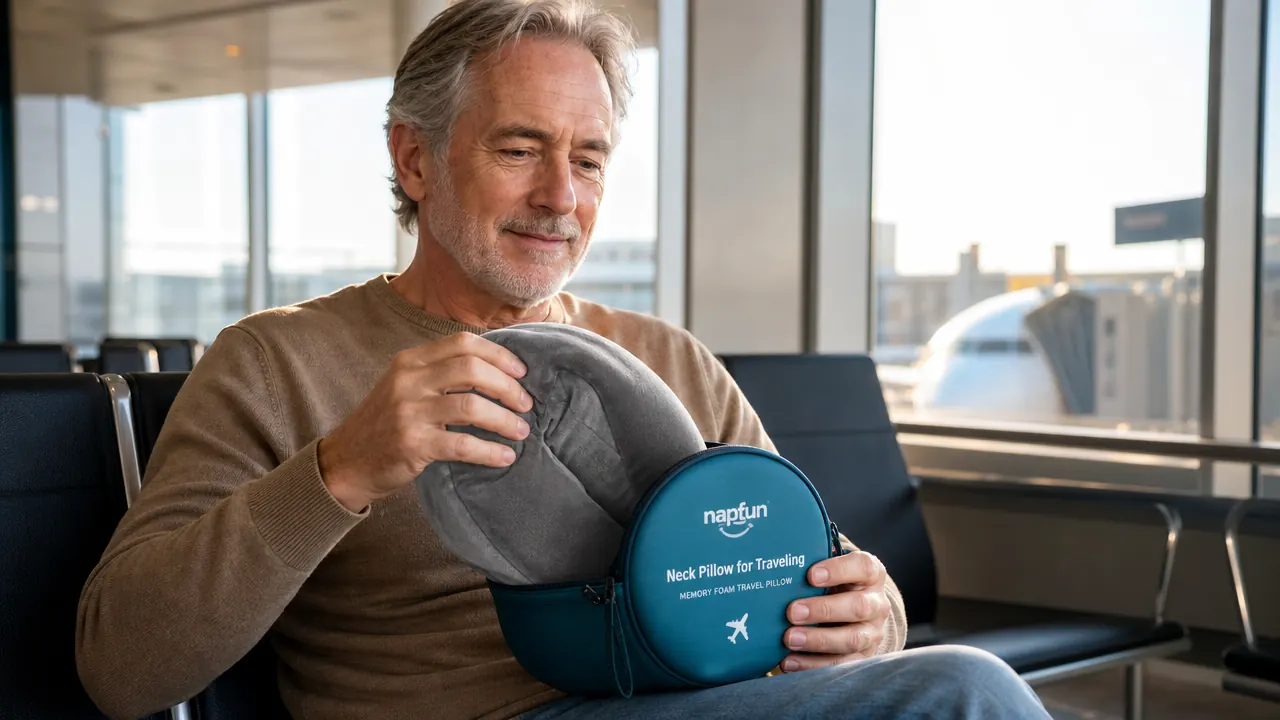
Memory foam does not compress as small as an inflatable pillow. That is just physics. The napfun comes with a compression sack that squeezes it down to roughly the size of a large grapefruit. The bag has a drawstring and a clip loop, so you can attach it to a backpack handle or strap. When compressed, it fits in a side pocket on most bags. When uncompressed, it is a full-size U-shaped neck pillow and takes up real space.
Getting it back into the compression bag after use is a genuine wrestling match the first several times. You have to squeeze the air out of the foam while simultaneously pulling the bag tight and cinching the drawstring. I eventually worked out a method: fold the pillow in half lengthwise, compress it against your chest, then slide it into the bag top-first before it can spring back open. Once you have the technique down it takes about twenty seconds. But there is a technique, and the manual does not explain it well.
Alternatives I Considered and Why I Stayed With This One
Before I settled on the napfun, I looked hard at the Cabeau Evolution Classic, which runs about forty dollars. The Cabeau has a flat back panel that lets you lean against a headrest without the pillow pushing your head forward, which is a real ergonomic advantage. If you always get a window seat or a seat with a proper headrest, the Cabeau might edge out the napfun on pure support. But at more than twice the price and with a carry bag that, in my experience, is not significantly smaller, I could not justify the jump for occasional travel.
I also looked at the Trtl Pillow, which is not a traditional neck pillow at all. It wraps around one side of your neck and holds your head from collapsing to the side. It works well for people who always sleep leaning in one direction. I am a back-and-forth sleeper, so it did not suit my habits. If you sleep consistently to one side, the Trtl is worth a look. For everyone else, a full U-shape like the napfun covers more positions. You can read more about positioning and sleep strategy in my guide on how to sleep on a plane without neck pain.
I have also compared the napfun directly against the Cabeau in a more detailed breakdown. If you are trying to decide between the two, that comparison covers price, foam density, and which type of traveler each one suits best. See the full napfun vs Cabeau Evolution comparison for the details.
Pros
- Genuine memory foam that holds its shape and returns to form between flights, even after eleven months
- Thick sidewall design keeps your head from rolling forward while you sleep, which is where neck pain usually starts
- Cover zips off and washes clean without shrinking or pilling when handled properly
- Compression bag with clip loop keeps it off your packing cube stack and on the outside of your bag where it belongs
- Over 20,000 Amazon reviews at 4.3 stars gives you a meaningful sample size beyond any single reviewer's experience
Cons
- Cover runs warm on stuffy flights, can leave a sweaty collar ring in hot cabin conditions
- Getting the pillow back into the compression bag requires a learned technique the manual skips entirely
- No flat-back panel, so if you lean against a headrest the pillow can push your head slightly forward
- Memory foam means it is heavier than inflatable options, though not by a lot
- Foam tends to feel slightly stiffer in cold cabin air, particularly at the start of an early morning flight
Who This Is For
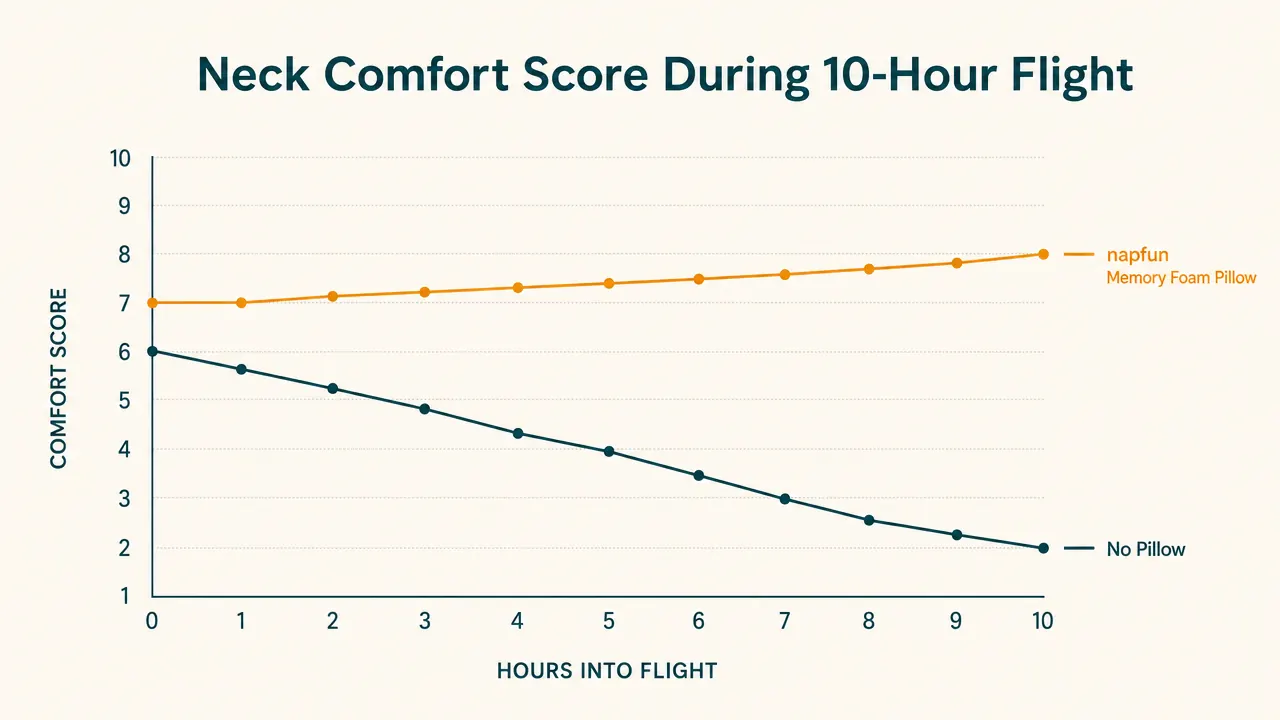
This pillow suits people who fly a few times a year to a few times a month and want real neck support without spending at the premium tier. It is especially good if you prefer window seats, tend to lean against the cabin wall, or if you sleep shifting from one side to the other rather than fixed in one direction. Travelers who suffer from chronic neck stiffness, like me, will likely notice the most difference compared to inflatable or polyester-fill alternatives. It is also a solid pick for anyone who has had it with pillows that compress flat after thirty minutes and stop doing anything useful.
Who Should Skip It
If you always fly business or first class and have an actual seat that reclines flat, you probably do not need a neck pillow at all. If you run extremely hot and every long flight already leaves you reaching for the air vent, the warm cover on this pillow is going to bother you. If you are a minimalist packer who counts grams and wants absolutely nothing on the outside of your bag, the grapefruit-sized carry sack may be one item too many. And if you fly sixty-plus times a year, the Cabeau or another premium option with a proper flat-back panel is probably worth the investment. For everyone in between, the napfun is a real product at a fair price.
Eleven months and seven flights later, this is still in my carry-on bag.
The napfun neck pillow is available on Amazon with free Prime shipping. Check today's price before you book your next flight.
Amazon Check Today's Price on Amazon →